Turning Everyday Objects into Storytelling Art
Okay, listen.
I used to think drawing random stuff on my desk was pointless. Like, who wakes up and says, “Today I’m gonna draw this stapler and change the world”? Nobody. Not even the stapler. But somewhere between boredom and caffeine overdose, I realized something — ordinary objects have stories, and I was too blind (or too busy scrolling) to see them.
Let’s be honest. We all chase the big ideas. Epic fantasy scenes, glowing cyberpunk cities, that one perfect character who will make your portfolio go viral. But here’s the truth: if you can make a cup of coffee look alive, you can draw anything. Because that’s what storytelling art really is — not fancy subjects, but how you see them.
The Problem with Drawing Boring Stuff
Let’s start with the mental block. You look around, see a spoon, and your brain goes, “Nah. That’s not art.” You’d rather draw a dragon. Because a dragon feels like art. But that spoon? That’s just where soup happens.
The trick is, dragons are easy. They scream for attention. A spoon doesn’t. It just exists. Quiet. Patient. Waiting for you to look closer. And when you finally do, you start noticing things — how the metal bends the light, how it curves into reflection, how its shadow stretches like a secret twin. Suddenly it’s not boring anymore. It’s cinematic.
Drawing simple things forces your brain to slow down. It’s like meditation, except instead of incense, you have crumbs and maybe a cold cup of tea nearby.
The Moment I Realized a Lamp Could Break My Heart
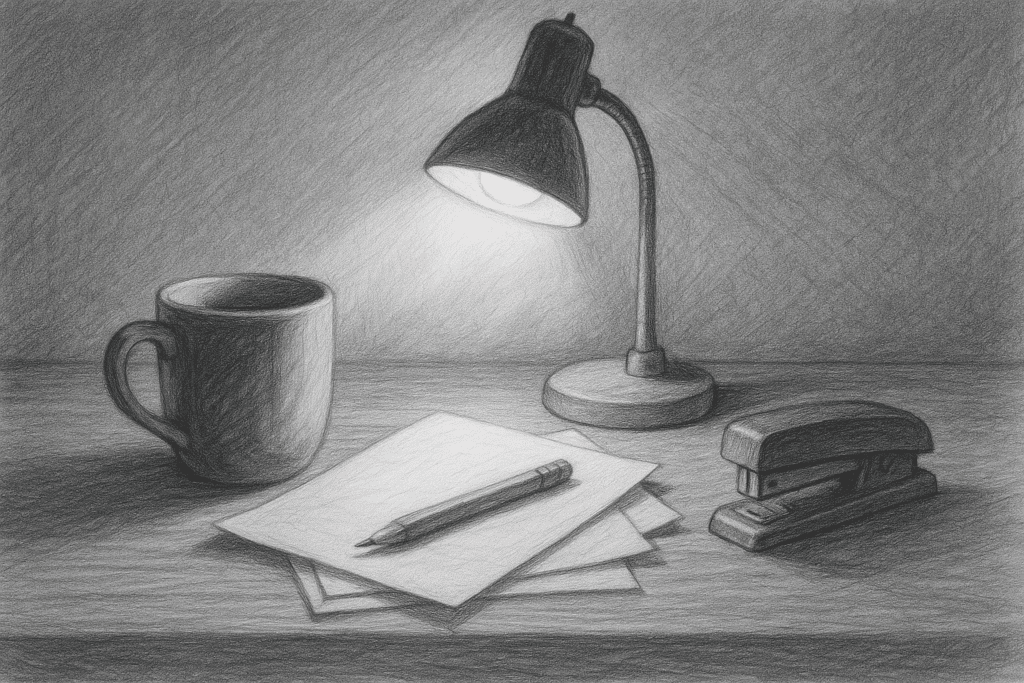
One night, my power went out. The only thing glowing in my room was this cheap desk lamp running on a backup battery. I started sketching it out of frustration. Nothing fancy, just the cone of light spilling over my notes.
Halfway through the drawing, something hit me. This thing — this piece of plastic with a bulb — looked tired. Like it had been holding the world together all night while everything else failed. That’s when it clicked: objects carry emotion. Not because they have feelings, but because they reflect ours.
That’s how you turn boring things into stories. You project your mood onto them, and suddenly they speak back.
Step One: Look Longer Than You Usually Do
You know how people look at their phones like it owes them money? That’s the same intensity you need when you stare at an object. Look at its edges, its reflections, its weird imperfections.
If you look long enough, you’ll start seeing tiny moments. A scratch that looks like a scar. A reflection shaped like a memory. Dust that catches light just enough to look like fog in a movie.
That’s your story. Right there in the crumbs and scratches.
Step Two: Give It Character
A toothbrush is not just a toothbrush. It’s a warrior with frayed hair who’s been fighting cavities for years. A coffee mug isn’t a mug. It’s a vessel of morning rituals, caffeine dependency, and broken dreams of waking up early.
When you draw, imagine the object as a character. What’s its history? What’s its attitude? Is it old and wise, or shiny and overconfident? Suddenly your lines change. You start drawing with personality instead of accuracy.
That’s when art gets interesting.
Step Three: Play With Lighting Like You’re Shooting a Movie
Lighting is where the drama lives. Don’t just copy what you see. Tilt the lamp. Kill the overhead light. Let the shadows stretch and crawl. That’s how you turn a spoon into a villain or a napkin into a saint.
Think of light as your director. It decides the mood. A harsh top light turns a pencil sharpener into a scene from a noir film. A soft glow from the side turns it into nostalgia.
Step Four: Simplify to Amplify
The biggest mistake? Over-detailing everything. When you try to capture everything, you lose the emotion. Cut the noise. Focus on the essence.
Ask yourself: what makes this object feel like itself? The curve? The shadow? The reflection? Keep that. Drop the rest.
Minimalism is not about removing things. It’s about revealing what matters.
Real Talk: The Day I Fell in Love with a Paperclip
It was Tuesday. I was late, tired, and probably dehydrated. There was a pile of paperwork and a lonely silver paperclip sitting on top of it like it owned the place. I sketched it without thinking. Just a few lines.
But the drawing looked… right. It had rhythm. The curve of the wire, the tension where it looped. It looked like it wanted to spring back into shape. That’s when I realized: even metal can feel alive if you pay attention.
I started filling pages with little objects. Scissors, pens, erasers, coins, receipts. My sketchbook turned into a diary of the unnoticed. And weirdly enough, people loved those drawings more than my detailed fantasy stuff.
The Secret to Making Mundane Things Beautiful
You don’t make them beautiful by adding glitter. You make them beautiful by listening. Every object has a form, a function, a story of use.
That stapler? It’s the sound of deadlines. That key? It’s freedom, privacy, or the memory of a place you no longer visit. That cup of coffee? It’s routine, addiction, comfort, and hope — all in one.
Your job as an artist is to translate that feeling into shape and tone.
The Exercise That Changed How I Draw
Here’s something to try right now.
Grab any three random objects near you. A spoon, a pencil, a coin. Put them together on a table. Rearrange them until they look like they’re talking. Maybe the pencil leans toward the coin. Maybe the spoon turns away dramatically.
Now light them from one side and sketch what you see.
Don’t draw what they are. Draw what they’re doing. Capture the relationship — distance, angle, attitude. It’ll look simple, but your brain will start building stories automatically.
Congratulations. You just made art out of nothing.
Common Mistake: Thinking It’s Too Simple
You’ll feel the urge to say, “This is too basic.” Don’t. Simplicity is not a weakness. It’s a test. Can you make something compelling without tricks? Without fancy props?
If you can, you’ve already leveled up.
Every master painter started this way. Before the dragons, there was a spoon. Before the landscapes, a cup. Before the masterpiece, a quiet study of something everyone else ignored.
Why Random Prompts Help You See Again
When you draw from a prompt, your brain stops autopiloting. It can’t rely on habits. That’s the magic. A random object generator throws weird things at you — a cracked teapot, a rusty nail, a lemon next to a compass — and your creativity wakes up.
It’s like creative weightlifting. The randomness forces you to improvise. To connect things that shouldn’t belong together. To make sense out of nonsense.
That’s when art starts to feel like discovery again.
Quick Story: The Apple and the Lightbulb
I once got a random prompt: apple + lightbulb. My first thought? “That’s dumb.” But I did it anyway.
The drawing turned into this surreal still life where the apple glowed from within, half fruit, half lamp. It looked ridiculous. It also became one of my favorite sketches. Because for once, I wasn’t chasing perfection. I was chasing curiosity.
That’s what random object drawing does — it reminds you to play.
If You Get Stuck
Don’t panic. Move your object. Change the light. Zoom in. Imagine it’s part of a movie still.
Ask yourself: what’s happening just outside the frame? What emotion does this object give off? What if it could speak? What would it say?
Sometimes the smallest shift changes everything.
The Bigger Lesson
When you draw the ordinary, you train your brain to see. That skill transfers everywhere — characters, environments, design, storytelling. Suddenly you’re not just copying shapes; you’re interpreting meaning.
Every object becomes a metaphor. A chair is comfort. A cup is longing. A closed door is mystery. Once you start seeing this way, you can’t unsee it.
That’s the real power of art — not just making things look good, but making them feel true.
Real Life Bonus: Why I Keep a Box of Trash
Yes, I have a “trash box.” It’s full of random junk I can’t throw away because they make great drawing subjects. Old keys, receipts, weird shells, a broken headphone jack.
When I feel stuck, I pull something out and draw it. Every time, it surprises me. The folds of the paper. The torn edge. The reflection of the metal. It’s like the universe whispering, “You don’t need new things. You just need new eyes.”
Final Thought: Ordinary Is the Shortcut to Extraordinary
If your art ever feels stuck or stale, stop looking for grand ideas. Look at what’s already around you. The magic isn’t out there — it’s literally on your desk, waiting to be noticed.
Every scratch, every dent, every smudge is a story. Your pencil is just the translator.
So next time you think, “There’s nothing to draw,” look again. That’s not emptiness. That’s opportunity.
And if you want a quick way to get started, I’ve got you covered.
👉 Try the Random Object Drawing Prompts
Go ahead. Let your coffee cup be a protagonist. Let your scissors have an identity crisis. Let your stapler be the villain. The world doesn’t need more dragons — it needs someone who can make a paperclip feel like destiny.
