How Word Mashups Train Your Creative Reflexes
Okay, so imagine this.
You open your sketchbook, ready to make something amazing, and your brain gives you nothing. Just static. A blank page, a pencil that suddenly feels too heavy, and that little voice whispering, “Maybe tomorrow.”
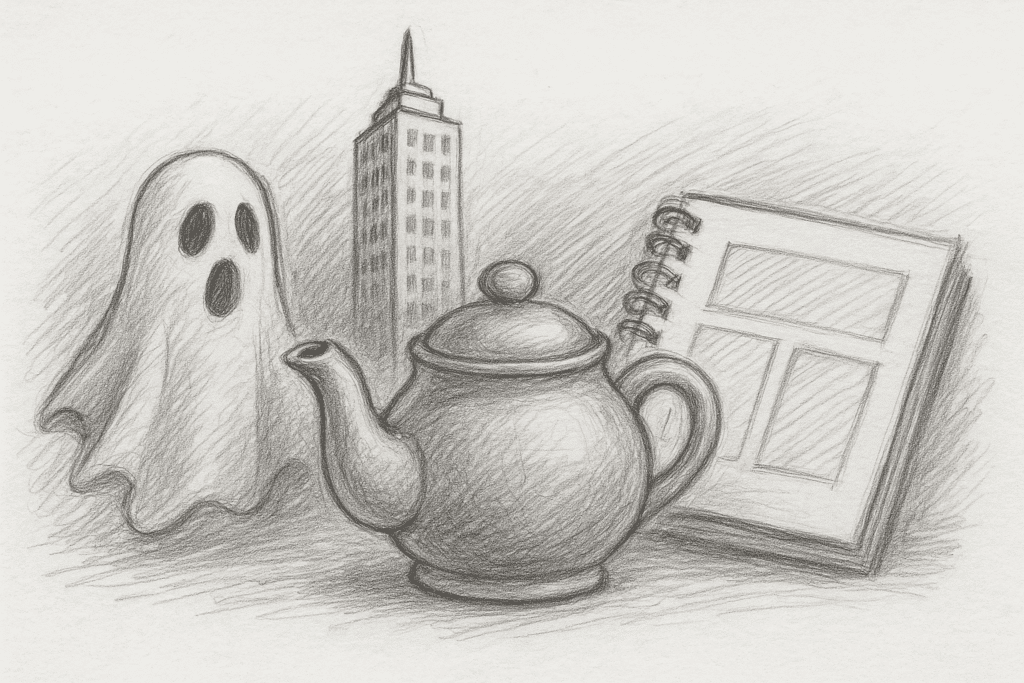
Now picture this instead. You pull three random words out of a generator — ghost, teapot, and skyscraper. Weird combo, right? But before your brain has time to say what the hell, your imagination starts running. What if there’s a ghost that haunts a teapot factory inside a skyscraper? Or a floating teapot city powered by spirits? Suddenly, you’re not bored anymore. You’re curious.
That’s the power of word mashups.
They’re not just random nonsense — they’re mental gym workouts for artists. They force your brain to make quick creative decisions, connect unrelated things, and find logic inside chaos.
Let’s break down why this works, how to use it, and what happens when you start drawing like your imagination just drank three espressos.
The Real Problem: You’re Too Smart for Your Own Good
Most artists get stuck not because they lack ideas, but because their brains love safety. You start sketching, and your hand automatically goes for the same shapes, same poses, same themes. Comfort zone city.
Word mashups smash that safety net. When you get something like banana warrior thunderstorm, your logical side freaks out — but your creative side wakes up. It starts asking, “Okay, how do I make that work?”
And that’s the moment your art brain starts doing push-ups.
Why Randomness Works Better Than Inspiration
Inspiration is moody. You can wait for it, but it’s like waiting for a text back from someone who clearly isn’t interested.
Randomness, on the other hand, doesn’t care about your feelings. It throws weird things at you and dares you to respond.
When your brain has to link unrelated words — say pirate, mirror, and mushroom — it starts digging into your creative memory bank. Pirates make you think of the sea, mushrooms make you think of forests, mirrors make you think of reflection or illusion. Your brain connects them into something new: a pirate trapped in a forest of glowing mushrooms that reflect his true self.
You didn’t overthink it. You just reacted. That’s creativity in its purest form.
My First Mashup Disaster (and How It Saved Me)
I once got octopus, candle, and cathedral. I thought, “Nope. Too weird. Not doing it.”
But I forced myself. I sketched an underwater cathedral where giant octopuses wrapped around candlelit pillars. The lighting looked wild, the reflections made no sense, and yet… it was one of the best pieces I ever did.
Because it didn’t feel like a safe drawing. It felt like a discovery.
That’s what these mashups do — they push you out of your default settings. You stop drawing what you know, and start exploring what you don’t.
The Psychology Behind It
Your brain has two main creative modes: associative and analytical. Analytical is when you plan and measure. Associative is when you connect ideas freely. Word mashups throw your associative mode into overdrive.
It’s like being a jazz musician — you don’t plan every note, you respond to the rhythm. You build patterns that don’t exist yet.
When you practice that skill regularly, you get faster at generating ideas. You become someone who can see stories in nonsense. And that’s exactly what professional artists do — they find meaning in chaos.
How to Do It Like a Pro
Step 1: Use a random three-word prompt generator (preferably this one).
Step 2: Don’t think. Just react. Draw the first image that pops into your mind, even if it’s absurd.
Step 3: Commit to it for 10 minutes. No deleting, no perfect lines, just flow.
Step 4: After the sketch, write a short note: “What’s happening in this scene?” That small reflection locks the idea in your creative memory.
Over time, your brain gets faster at visualizing. You’ll start connecting things on instinct. That’s your reflex training in action.
Why It Feels So Rewarding
Here’s the secret: your brain loves solving problems. Every random word combo is a small puzzle. Each time you solve one, you get a little hit of dopamine — the same chemical you get from food, likes, or small victories.
That’s why this exercise feels addictive. It’s not just fun. It’s literally rewiring your brain to crave creation.
The “Weird First Draft” Rule
Every time you start a mashup sketch, it’s going to look dumb at first. That’s normal. The weirder it looks, the better. Because weird is where originality lives.
Nobody remembers a perfect apple drawing. But everyone remembers the apple that turned into a dragon wearing sneakers.
When you give yourself permission to be ridiculous, your art stops trying to impress and starts to express.
How Mashups Fix Art Blocks
Art block is basically decision fatigue. Too many choices kill momentum. Word mashups give you just enough structure to start.
Think of it like bumpers in a bowling alley — you still have to throw the ball, but it keeps you from falling into the gutter.
You’re free, but not lost.
A Quick Game to Play Anywhere
- Open your notes app.
- Write three random nouns. Don’t censor yourself.
- Imagine they all exist in one world. Who lives there? What’s happening?
- Write or sketch it in 5 minutes.
I once got bicycle, volcano, and rabbit. Ended up with a rabbit racing down a volcano on a molten bike. Was it stupid? Yes. Was it fun? Absolutely. And that’s the point.
Creativity is a muscle — not a mood.
Why Your Sketchbook Will Look Like Chaos (and That’s Good)
After a week of doing mashups, your sketchbook will look like the diary of a mad scientist. A crocodile wearing a crown, a toaster knight, a city made of mushrooms — pure chaos.
But here’s the thing: hidden in that chaos are gold nuggets. Visual ideas you’ll reuse later. Shapes, gestures, silhouettes that become real projects.
The best artists aren’t neat — they’re explorers with messy maps.
The Confidence Effect
Something changes when you draw without fear of failure. You stop treating your sketchbook like a museum and start treating it like a playground.
You’ll notice you start experimenting more in other areas too. Different styles, compositions, even storytelling choices. Because once your brain learns that weird is safe, it stays curious.
That’s the foundation of originality.
How to Turn Mashups into Finished Pieces
Start small. Pick one mashup you liked and refine it. Add lighting, color, or story elements. You’ll see how that random nonsense evolves into a full artwork.
What started as wolf, violin, storm becomes a dramatic portrait of a musician under lightning.
That’s when you realize — this stuff isn’t random at all. It’s your subconscious giving you clues about what excites you.
My Favorite Prompt Combo So Far
“Cathedral,” “mirror,” “insect.”
I ended up sketching a gothic cathedral made entirely of mirrored insect wings. It looked like glass and bone fused together. Creepy? Yes. Beautiful? Also yes.
That’s the beauty of word mashups — they don’t ask if something makes sense. They ask if it feels right.
Final Thought: Embrace the Chaos
Art isn’t about control. It’s about connection — between ideas, shapes, emotions, and accidents. Word mashups are controlled chaos, and they train you to see patterns where there were none.
So next time your brain goes blank, don’t wait for inspiration. Go generate chaos.
Let your imagination stumble, trip, and get weird. That’s where the good stuff lives.
👉 Start with the Three-Word Mashup Generator
Because three random words might just unlock the best idea you’ve had all year.
