Turning Vast Landscapes into Miniature Emotional Movies
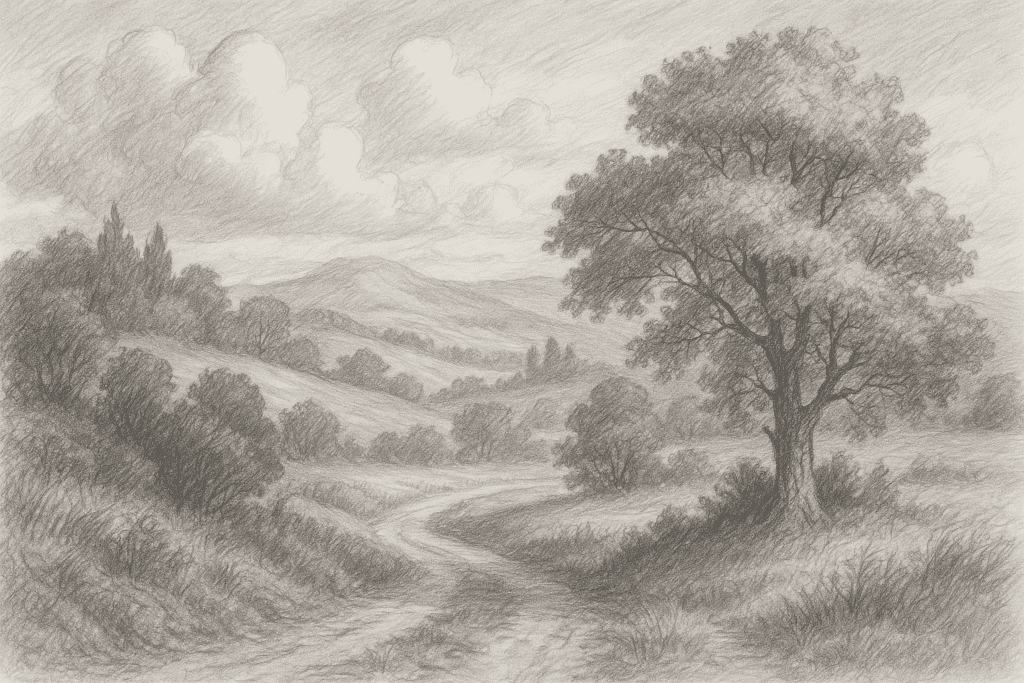
Okay, real talk.
Most people think landscape art is about copying nature. You see a mountain, you draw the mountain. Simple, right? Except — no. That’s how you end up with a lifeless postcard, not a living picture.
Real landscape drawing isn’t about what you see. It’s about what it feels like to be there.
The wind. The air. The quiet weight of distance. That invisible line between “just a sketch” and “I can smell the rain in this drawing.”
Let’s unpack how to capture that feeling without overcomplicating your art.
Step One: Don’t Draw the Landscape. Draw the Space Between Things.
When you start a landscape, your first instinct is to draw the mountains, trees, and sky. But here’s the secret — the real story lives in the negative space.
The gaps between branches. The mist between hills. The shadow where sunlight stops.
Draw those spaces with as much care as the objects themselves. Suddenly, your drawing breathes.
A blank area isn’t “empty.” It’s air. And if you treat it like air, your scene feels real.
Step Two: Stop Copying Photos
Photos lie. They flatten. They kill depth.
When you draw from a photo, your brain copies instead of seeing. But if you sketch from life — or from memory — you have to interpret. You start asking questions like, “Where’s the light coming from?” and “What mood do I want this to have?”
That’s the moment art happens. You stop tracing reality and start bending it to emotion.
So if you can, go outside. Even if it’s just your backyard. Draw what the air feels like.
Step Three: Think Like a Movie Director
Every good movie frame has a composition — foreground, midground, background.
Do the same in your drawings.
Add something close-up (rocks, grass, fence), something middle-distance (trees, water, hills), and something far away (clouds, horizon, fading color). That layering gives your viewer a way to enter your drawing.
Without depth, your landscape is just a wallpaper. With depth, it’s a journey.
Step Four: The Mood Is in the Light
Light isn’t just brightness. It’s storytelling.
A high, white sky feels empty. A low, golden light feels hopeful. A dark horizon under a storm cloud feels cinematic and heavy.
Before you start shading, decide the time of day. Even black-and-white pencil sketches can carry the feeling of morning, dusk, or night — all through contrast and softness.
Think of light as your dialogue with the viewer. What do you want to say?
Step Five: Simplify Like a Poet
Poets don’t describe everything. They pick details that matter and leave space for imagination.
Do the same with your pencil.
You don’t need every leaf, every ripple, every grain of sand. Suggest, don’t explain. A few confident strokes are worth more than fifty cautious ones.
When in doubt — stop drawing sooner. Let silence finish the sentence.
Step Six: Capture Movement in Stillness
Wind, water, fog — they move, even in drawings. You can’t animate them, but you can imply motion.
Use direction lines. Flow your strokes with the wind or the water. Use curved shading to mimic drift and pull. Don’t freeze the world; let it breathe.
If your landscape feels like it’s about to move — you nailed it.
Step Seven: Give It a Soul
This one sounds cheesy, but stay with me.
Every place has a soul. You’ve felt it — that weird emotional echo you get when you stand somewhere quiet.
When you draw a landscape, think about what that place feels like. Peaceful? Lonely? Wild? Forgotten?
Your choices — shading, detail, direction, texture — will all shift subtly to match that emotion. That’s how art starts whispering to people without words.
A Little Story
I once drew a small sketch of a powerline cutting across a foggy field. It wasn’t dramatic. No mountains, no castle, just a wire and grass.
Someone saw it and said, “This feels like home.”
That’s the goal. Not perfection. Connection.
Practice Challenge
Here’s a five-day exercise to reboot your landscape drawing instincts:
Day 1: Sketch a tree, but don’t draw the leaves — only the light and air around it.
Day 2: Draw a body of water, but make the ripples the focus.
Day 3: Choose a horizon and draw the feeling of distance, not the detail.
Day 4: Create a storm scene using only pencil direction and contrast.
Day 5: Mix reality and memory — draw a real place, but change the lighting to match your mood.
Each one teaches you to see instead of copy.
Why It Matters
Landscapes remind us that the world is bigger than us — and smaller, too. You can hold an entire mountain range on a sheet of paper and still make it feel infinite.
That’s power. And it doesn’t come from talent; it comes from observation. From paying attention to how things breathe, fade, and change.
When you draw a place with honesty, you bring it back to life — not as it is, but as it feels.
Final Thought
Don’t wait for inspiration. Go outside. Pick a view — even if it’s just your street corner. Watch how light hits the wall, how the air turns edges soft.
That’s your art. It’s right there, every day, waiting for you to notice.
👉 Explore Landscape & Scenery Drawing Prompts
Because sometimes, the best world you can draw is the one you’re already standing in.
